



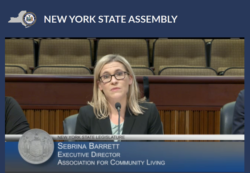
Today, on behalf of ACL Members across NY, Executive Director Sebrina Barrett is testifying at an Assembly Hearing on NY’s Mental Health Workforce. You can watch the live feed of the hearing here: https://nystateassembly.granicus.com/MediaPlayer.php?view_id=5&event_id=2995
Please see her testimony below:

Assembly Standing Committee on Mental Health
Aileen M. Gunther, Chair
Hearing on mental health workforce
Tuesday, November 9, 2021, 10 a.m.
Legislative Office Building, Hearing Room C
Sebrina Barrett, Executive Director, Association for Community Living
“My name is Sebrina Barrett, and I am the executive director for the Association for Community Living. Our members provide a home and path to recovery for about 40,000 New Yorkers with severe and persistent mental illness.
Thank you for holding this hearing on an important issue that is severely impacting mental health providers across the state — we know workforce shortages are especially impacting mental health housing providers, who have remained open throughout the pandemic, leaving behind staff who are exhausted, defeated and grieving. The past 20 months have been incredibly challenging for the mental health housing workforce, causing many of them to seek employment elsewhere. For those who remain, the need to work extra hours to fill the gaps is taking its toll, and is unsustainable.
While no industry seems immune from workforce shortages seemingly related to the pandemic, the staff vacancy rate in New York State’s mental health housing system was a concern before COVID, and it has only gotten worse. We surveyed our members; we asked them how many of their positions were vacant during a specified week. This is what our members reported:
Last October, the statewide vacancy average was nearing 15%; it then grew to 19% in May 2021, and again to more than 23% in October 2021. This means that nearly one in four positions statewide are vacant.
Moreover, during our survey period, we also gathered information on how many staff were unavailable to come to work for any reason, such as illness, vacation, and child care issues. We learned that when the vacancy and unavailability rates were combined, 34% of the staff positions were unfilled that week — meaning 1 in 3 positions required coverage. Some regions reported even worse numbers, with the Hudson River Region having a 42% unavailability rate, and the Central Region having a 45% unavailability rate.
Practically speaking — what does this look like? How do housing providers keep their programs open without more than one-third of their workforce? Executives and other senior-level employees are filling direct care roles.
Imagine that you are short-staffed and, instead of being here today, to hear our testimony, you have to be in your office, sorting mail, filing documents, and circulating bill memos. Not only is this inefficient, these tasks, while necessary, are not the best use of your time.
That is what is happening in mental health housing. Chief Operations Officers, Chief Financial Officers, HR Managers, and Program Managers are all working direct care shifts. They are transporting residents to medical appointments, helping them manage their medications, and ensuring their living environments are safe. These are all important tasks, but not what these individuals were hired to do.
Not only does this negatively impact the operation of these housing agencies, but it also negatively impacts the residents and their recovery. Residents deserve consistent and competent care-givers with whom they can build trust. Further, when programs are short-staffed, health and safety become significant concerns. Serious illness and even death can occur when there are not enough staff to ensure residents’ well-being.
We were pleased to see Governor Hochul’s announcement of $21 million to fund mental health workforce recruitment and retention; however, residential programs are not eligible for this funding. Our understanding is there will be separate federal funding available to residential programs that rely on Medicaid, but that will only benefit about 25% of the mental health housing workforce, leaving the majority of the staff out and causing inequities that could lead to much worse vacancy rates in the programs that do not receive these funds.
With rising inflation and wages, an across the board adjustment is needed to prevent further erosion of funding. Due to decades of neglect, rising inflation and fair market rent values rising sharply, these programs need $177 million just to make up for years of underfunding. Further, it is imperative that the 5.4% human services COLA be funded, so that we can move toward providing these essential workers with a living wage. We need funding to raise wages and support other recruitment and retention incentives. We can’t wait for action. The time to address the workforce crisis is now.”
###